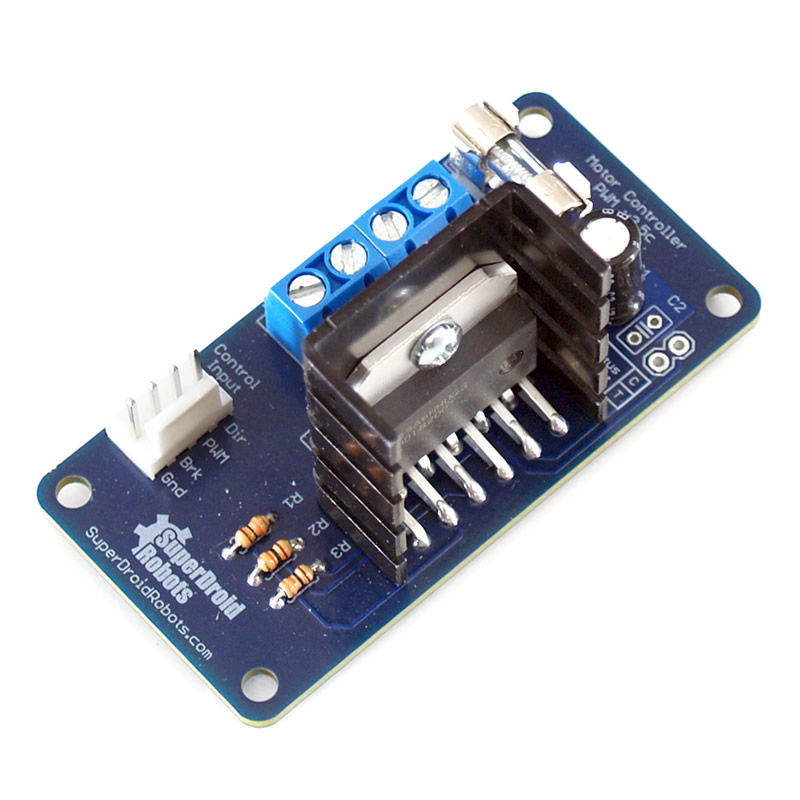
This is our custom RC interface board. It was developed for our ATR robot kits. In order to control motors or any heavy load from a standard hobby remote controller you need to be able to take the signals (pulses) that are typically used to control servos and use them to control motors and other heavy loads. This RC board does just that! The RC board accepts 4 RC inputs (4 channels) and drives 2 PWM motor controllers and 3 relays (two 10A SPDT and one 8A DPDT relay).
The board has a onboard 5V regulator and fuse for power. There is a jumper that allows you to power the RC receiver via the board or isolate the receiver power from the RC interface board. The board also has 3 LEDs showing the status of the the 3 relays and 4 LEDs showing the status of the 4 RC channels.
The PWM output is an 8 pin header. The outputs are the PWM signal, brake (on/off), and direction for each channel and two ground pins. The PWM outputs a 2000hz signal equivalent to 0-5V. The board is intended to be used with our PWM motor controllers. Center stick will be 0 volts, then full stick in either direction will yield 5V and in one direction the direction output will turn on to change the direction of the motor. You can run the PWMs in parallel. For our large motors on our ATRs we run one PWM per motor (or 2 PWM motor controllers to each channel). The PWM motor controllers can be hooked up using our PWM to RC hookup kit. We have found that the combination of this controller with our PWM motor controllers dramatically increases the performance of the robot both in range and control. The controller has been programmed to filter and dismiss most erratic or lost readings. If it loses to much data it will shut the controllers down into a safe mode and wait until it gets several good readings in a row before starting back up. Depending on the transmitter and receiver, dozens of readings are taken a second.
The RC controller PWM output can be set on as two independent controlls or the channels can be mixed. In independent mode, each PWM responds individually to the output of the RC receiver. So if you want to use only one PWM or have two independent PWMs you can use this mode. In mix mode it will take two channels (a fwd/rev stick movement and a left/right stick movement) and blend them together to control the two PWM controllers. Both channels have to be hooked up or neither PWM will work when set to this mode. Mix mode is intended for tank steering or skid steering. Pushing the stick proportionally forward will drive both PWMs proportionally forward, same for reverse. As the stick if moved forward or reverse, then moving the stick to the left or right will turn the robot left and right by baking off the appropriate motors. If from center stick the stick is pushed left or right the robot will pivot left or right by driving one motor forward and the other in reverse.
The relays can be used in many capacities. One of the SPST relays operates off of one of the channels as an on/off or off/on relay for driving things like lights. The other SPST relay works along with the DPDT relay off the other channel. Mode select DIP switches allow you to configure how you want operate the relays. It can drive many different things and can also be set up to drive a motor forward/off/reverse. The table below shows how the switches can be used to set up relays. Please note Channel 3, and 4 only refer to the channel numbering on the RC interface board, you can plug them into any channel on your receiver to have them operate from the RC channel you desire. The controller reads the switch groups in order, it will process the 1st switch selected in the group.
| x |
Off |
On |
| Group 1 - PWM Channels - - RC Channel 1 & 2 |
| SW1 |
Independent PWM control |
PWM Mixing |
| Group 2 - SPDT Relay1 - RC Channel 3 |
| SW2 |
OFF |
Relay1-OFF-Relay1 |
| SW3 |
OFF |
Relay1-OFF-OFF |
| Group 3 - SPDT Relay2, DPT3 Relay3 - RC Channel 4 |
| SW4 |
OFF |
Relay2&3-OFF-Relay2 |
| SW5 |
OFF |
Relay2-OFF-Relay3 |
| SW6 |
OFF |
Relay2&3-OFF-Relay2&3 |
| SW7 |
OFF |
Relay2&3-OFF-OFF |
| x |
The three positions for the relays are each side of center and center stick. Center stick will be off. The relays will turn on about 1/3 stick, but if the radio has ATV or EPA you can vary when the relay comes on. You can reverse the channels of your RC transmitter to get the opposite responses. |
This board comes as a kit. All the components are top side mounted. There are no surface mounted components and all the holes are spaced out at least 0.1". As an option you select to have us assemble and test it.
As another option you can select to get RC connection cables. These plugs will plug into your receiver and solder into the RC controller board. Select the appropriate number of connectors, depending on how many channels you plan on driving.
Download the assembly and operation manual here.