
ARM mbed NXP LPC1768 Development Board
 
Category
Looking for an ARM-based microcontroller? ARM has been the most widely used 32-bit instruction set architecture since the 1980s.
The Pololu 3pi robot is a complete, high-performance mobile platform featuring two micro metal gearmotors, five reflectance sensors, an 8x2 character LCD, and 3 user pushbuttons, all connected to a C-programmable ATmega328 microcontroller.
Category List
ARM mbed NXP LPC1768 Development Board
Item Details
ARM mbed NXP LPC1768 Development Board
Item Name:
ARM mbed NXP LPC1768 Development Board
Item #:
MCU-053-000
Your Price:
$59.00
In Stock!
Quantity:

Product Image Gallery:

Overview

The mbed NXP LPC1768 development board from ARM enables quick and easy creation of high-performance prototypes. Based on the powerful NXP LPC1768 Cortex-M3 processor, which runs at 96 MHz and offers 512 KB flash and 64 KB SRAM, the 32-bit mbed can handily outperform popular 8-bit prototyping platforms like the Arduino and Basic Stamp. The mbed NXP LPC1768 also offers peripherals not typically found on lower-performance prototyping boards, such as ethernet, USB OTG, a 12-bit ADC, a 10-bit DAC for a true analog voltage output, in addition to more common interfaces like serial (UART), SPI, I2C, and CAN. The mbed has a 40-pin DIP form factor with 0.1"-pitch male header pins already soldered in, so it can be used with standard solderless breadboards and perfboards. (Note that while standard DIP ICs have a row spacing of 0.6", the mbed rows have a spacing of 0.9".)

One of the strengths of this platform is the mbed Library, which provides an API-driven approach to coding that eliminates much of the low-level work normally associated with MCU code development. Code can be developed using meaningful peripheral abstractions and API calls that are intuitive and well tested, freeing you up to experiment without worrying about the implementation of the MCU core or its peripherals.

Another key feature of the mbed is its unique C++ compiler and IDE. These free tools are entirely web-based and run online, which means there is no software to download or install. Supported browsers include Internet Explorer, Firefox, Safari, or Chrome running on a Windows, Mac, or Linux PC. You can log in from anywhere and simply pick up where you left off, and this approach makes it very easy to share code with others. And, since you’re working with a web-based tool, you can be confident that it is already configured and will stay up-to-date. The compiler uses the ARM RealView compile engine, so it produces clean, efficient, optimized code that can be used free-of-charge, even in production. Existing ARM application code and middleware can be ported to the LPC1768 microcontroller, and the mbed tools can be used alongside other professional production-level tools, such as Keil MDK.

No external programmer is required to program the mbed. When connected to your computer via the included USB cable, it shows up as a mass storage device. Simply save the compiled binary file to the board to program it.

Features

  • Can be powered by USB or an external 4.5 – 9 V supply (supply voltages up to 12V should generally be safe, but at these voltages the regulator may start to overheat if used to power external components)
  • Compact module: 54 mm × 26 mm
  • Convenient form-factor: 40-pin DIP (0.9" row spacing), 0.1" pitch
  • Drag-and-drop programming, with the board represented as a USB drive
  • Best-in-class Cortex-M3 hardware
    • 96 MHz ARM with 64 KB of SRAM, 512 KB of Flash
    • Ethernet, USB OTG
    • SPI, I2C, UART, CAN
    • GPIO, PWM, ADC, DAC, DMA
  • Easy-to-use, free online tools
    • Web-based C/C++ programming environment
    • Uses the ARM RealView compile engine
    • API-driven development using libraries with intuitive interfaces
  • Comprehensive help and online community
  • On-board LEDs can be used for feedback, and a serial port over the USB connection allows for printf-style debugging

Getting Started

Getting started is as simple as using a USB Flash drive. Simply connect the mbed NXP LPC1768 board to a Windows, Mac, or Linux computer and it will automatically appear as a USB drive. Follow the link on the board to connect to the mbed website, where you can sign up and begin designing. There are no drivers to install or setup programs to run. Getting started is so easy that you can have a “Hello World!” program running in as little as five minutes.

The mbed development board includes the necessary USB A to mini-B cable, a printed quickstart guide, and two business cards that contain a life-size pinout diagram for the mbed.

The following videos show just how easy it is to get started using the mbed:

File downloads

  1. mbed NXP LPC1768 schematic (70k pdf) mbed schematic (for advanced users).
  2. NXP LPC1768 user’s manual (5MB pdf) User’s guide for the mbed’s Cortex-M3 MCU (for advanced users).
  3. NXP LPC1768 datasheet (2MB pdf) Datasheet for the mbed’s Cortex-M3 MCU (for advanced users).

Recommended links

  1. mbed handbook All of the resources you need to get started with the mbed, including hardware information, software libraries, and support from the mbed community.
  2. Home-made m3pi robot controlled by Bluetooth keyboard An mbed notebook (in Japanese) showing a 3pi robot with an ARM mbed controlled by Bluetooth keyboard. By Kazuhiro Ouchi, December 2010.
  3. mbed Library for the LSM303DLH This is a library for the ARM mbed development board that interfaces with the LSM303DLH 3D compass and accelerometer carrier and provides the tilt-compensated magnetic heading. It can be easily modified to work with the newer and very similar LSM303DLM 3D compass and accelerometer carrier by swapping the magnetometer Y and Z registers. This library was not written and is not maintained by SDR.
 
The mbed NXP LPC1768 is an easy-to-use MCU development board designed for rapid prototyping.
Related Items
Arduino Mega 2560 R3
MCU-049-000
The Arduino Mega 2560 is a microcontroller board based on a ATmega2560 AVR microcontroller. It has 70 digital input/output pins, a 16 MHz resonator, a USB connection, a power jack, an in circuit system programming (ICSP) header, and a reset button.
$43.76
In Stock!

Pololu 3pi Robot
TP-041-000
The Pololu 3pi robot is a complete, high-performance mobile platform featuring two micro metal gearmotors, five reflectance sensors, an 8x2 character LCD, a buzzer, and three user pushbuttons.
$99.95
In Stock!

New Items
IG32 Mecanum Wheel Vectoring Robot Platform
TP-094-004
This is a direct drive 4WD base robot kit that uses Nexus mecanum wheels and hubs. Its a great robot platform for indoor robotics. It can vector in any direction.
$720.01
In Stock!
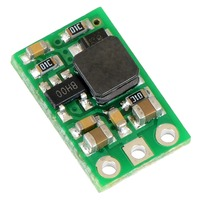
Pololu 5V Step-Up Voltage Regulator U3V12F5
TE-173-005
The compact (0.32"×0.515") U3V12F5 switching step-up voltage regulator takes an input voltage as low as 2.5 V and efficiently boosts it to 5 V. The pins have a 0.1" spacing.
$3.95
In Stock!
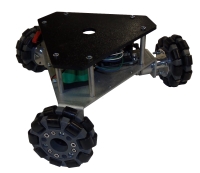
IG32 Triangular Omni Wheel Vectoring Robot Platform
TP-093-003
This is a direct drive triangular base robot kit that uses Nexus wheels and hubs. Its a great light duty robot kit great for indoor robotics that can vector in any direction.
$532.37
In Stock!
Powered by SuperDroid Robots, Inc