SuperDroid V
Autonoumous Robots


Autonomous Robots

Home
On-Line Store
Products Overview
OOPic Products
OOPic Accessories
RS232/TTL Converters
Sensors
Electronics
Robot Chassis & Drive
Robot Kits
LCDs
Robot Building Tools
Services
Used Products
SuperDroid Trekker
Description
What does it do?
Advantages
Trekker Robot Kits
Trekker Downloads
Trekker Pictures
Trekker Videos
Scholastic
Overview
Projects
General
Other Downloads
Microcontrollers
Related Links
Soldering
SuperDroid History
SuperDroid Development
BattleBots
Site
Feedback
Search
Contact Us / Information


SuperDroid V was started in December 1992. It was a welded aluminum framed robot with one front drive wheel that turned and two followers that had encoders attached to them. The Robot was controlled with a standard PC with I/O cards to control the motors and read the encoders. A lot of work and many modifications were put into this robot.  It was eventually retired so the next generation robots could be created.  The following list of functions were available:


Drive motor: on/off/fwd/rev/slow/fast


Steering motor: on/off/left/right


Steering Encoders: 500cpr with a Zero Reset


Drive follower wheel encoders: 500cpr


Base Motor: on/off/CW/CCW


Base Encoder: 500cpr with a Zero Reset


Head Motor: on/off/CW/CCW


Head Encoder: 500cpr with a Zero Reset


Ultrasonics: Head and Base


Speech: via onboard soundcard and speaker/amp


The robot was originally programmed with Quick Basic and then evolved into Visual Basic 5 then VB6. The program ended up being about 30,000 lines of code to program and control the robot. The main startup screen is shown below:

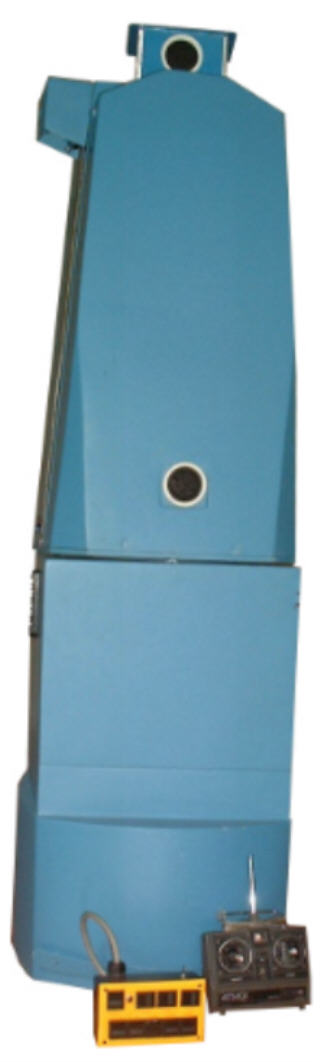
The robot was designed to look somewhat human like and stood about 6'4" tall with a CRT monitor for a head, which was subsequently removed.  The CRT on the head was not too beneficial because to troubleshoot you had to chase the robot around.  The monitor was replaced with a network and the base computer would emulate the robots computer.  If the network was removed the robot computer was self-sufficient and could run on its own.  The network was for troubleshooting, etc.  The eventual plan was to use a wireless network.  In order to troubleshoot, the system status needs to be transmitted to the stationary base.  SuperDroid VII�s control system is capable of doing this with a Wireless Communications Module (WCM).  

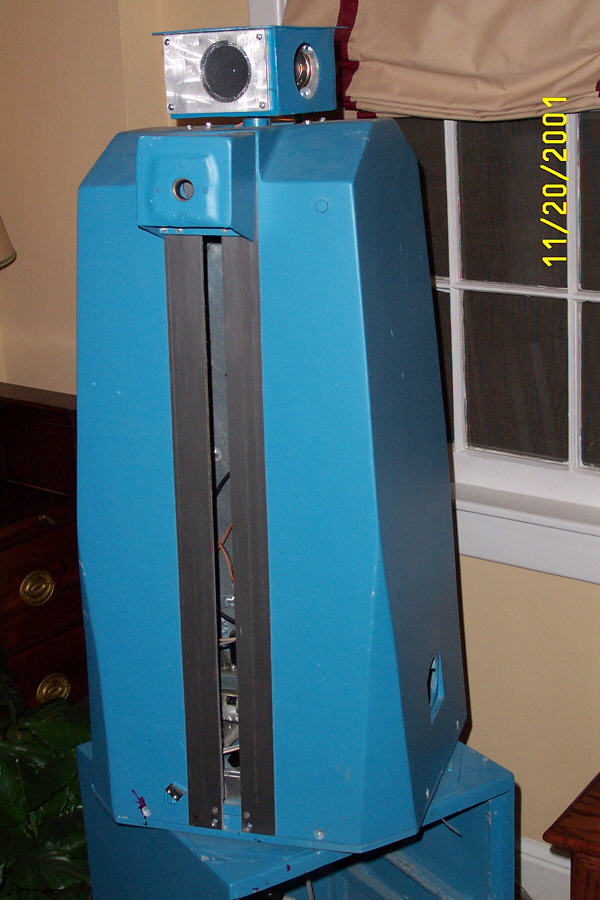
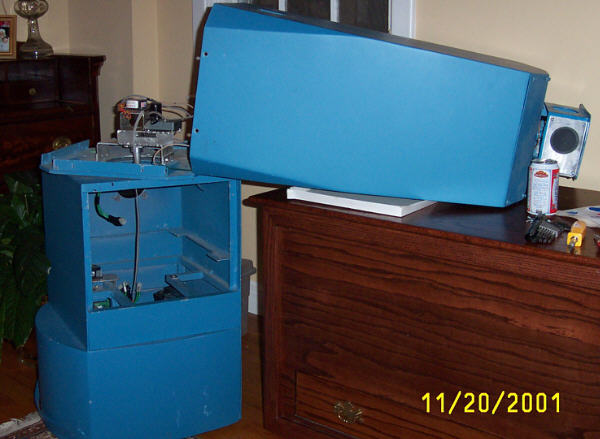
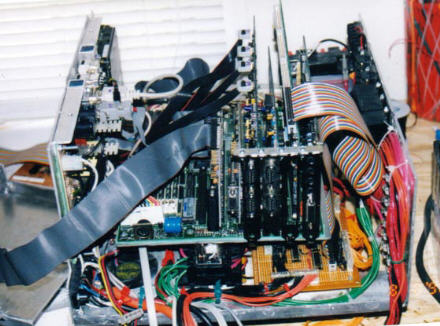
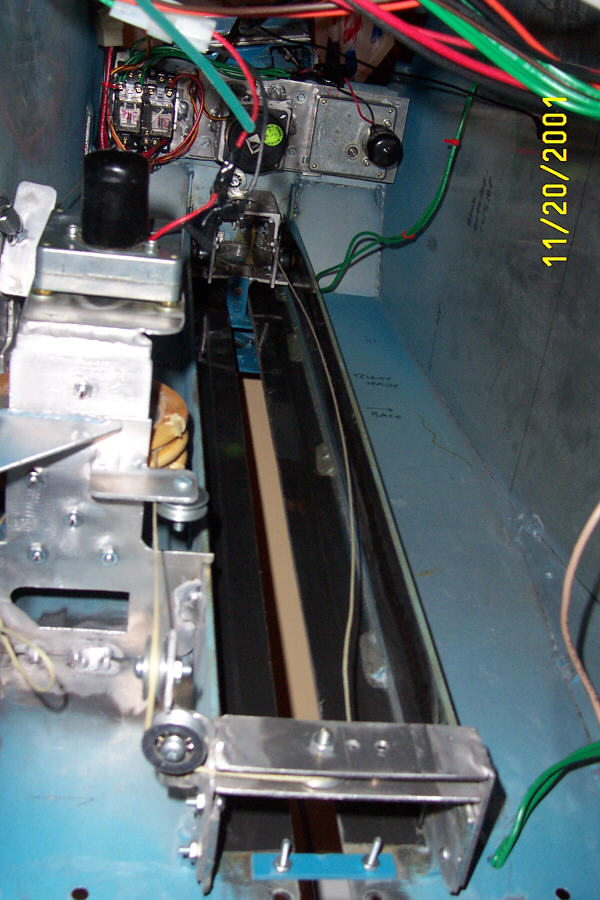
The arm slid up and down the side of the robot so it could pick thinks up off the floor (without bending at the waist). The shoulder function was completed, but the rest of the arm never was completed. The drawing below illustrates the design and functionality of the arm. The pictures below show many of the design features of SuperDroid V.

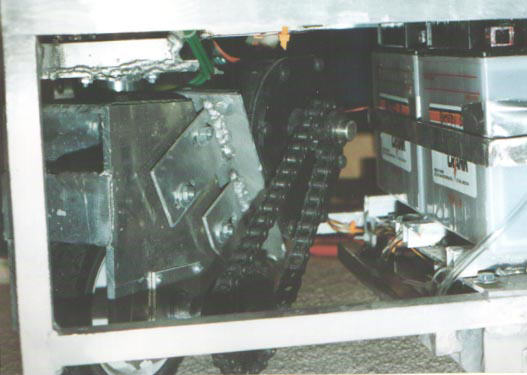
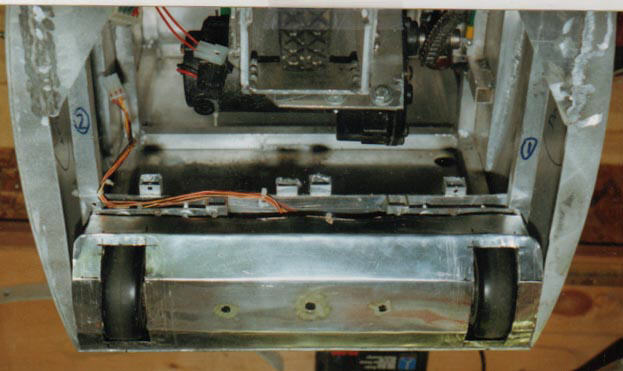
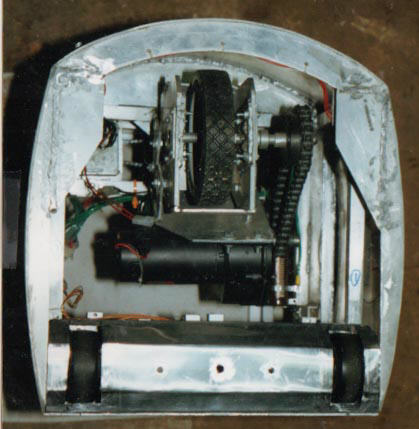
The Drive was one drive wheel with two encoder wheels in the back.  The drive wheel was able to turn very sharp.  The one drive wheel has some benefits such as cost, etc., but much harder to control.  To drive the wheel was positioned to the desired angle using and encoder for very accurate positioning.  The drive motor would turn on and the steering would adjust by pulsing the steering motor left or right as needed.  In order to do this successfully involved extensive programming. The pulses would be increased or decreased based on degree of offset.  The program would constantly monitor the robot’s trajectory and try to correct before it got off course.  The robot would also auto loop tune in order to adjust for varying surface conditions and battery voltages.  The Robot would be able to stay on its path with only a 2” variance from it projected path.  With the encoders on the it was able to position itself very accurately.  At the conclusion of the step depending on how accurate a final position was programmed in, it would fine tune its position until being within the desired tolerance.

As anyone who has used encoders knows, they have their inaccuracies.  The encoders were not the drive wheels, so if the motor accelerated too fast or otherwise slipped it would not affect the distance the program thought it moved.  The problem comes from slip while taking turns, any inaccuracy in the alignment of the wheels, etc.  Its not major, but it slowly adds up.  SuperDroid V could drive back and forth in a straight 20-foot path multiple times before loosing its accuracy.  Usually about a �” left/right positional tolerance per 20 feet could be expected.  The error gets worse when taking turns or running on carpet; Hence the Ultrasonic sensors.  Two sensors were used.  One sensor was used on the Base and one on the head.  The base and head’s angles were know to better than a � degree using encoder readouts.  The two sensors were used to verify the robots position and re-baseline its position off know targets.  Using the two sensors, the head and base could rotate separately and determine perpendicular angles off fixed walls and distances.

(Click on the images to enlarge the view)

SuperDroid V

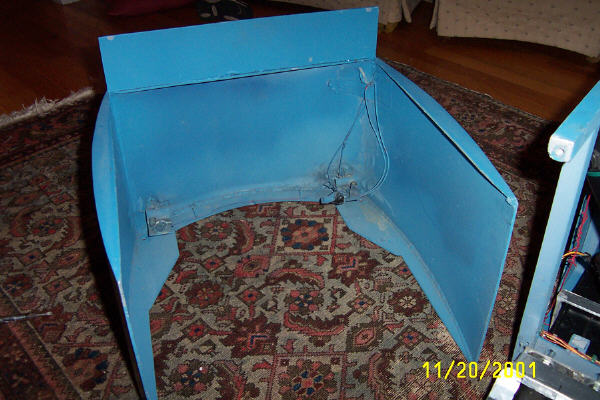
Robot Shell

Robot Shell

Robot Sliding Shoulder

Robot Top Opened for Maint. or troubleshooting

Robot Computer Control

Arm Assembly Relay Rack

Wire Remote

CPU

Lower Electrical (CPU removed)

Rotating Head

Rotating waist assy.

Rotating waist with top half opened

Shoulder Elevation Winch

Shoulder Elevation Winch

Lower Shell

Lower Half

Removable Base Shell

Lower Assy

Front Drive

Old Encoder Assy

Drive Encoder

Drive Encoders

Drive Assy Bottom View

Drive (no encoders)

Drive with encoders

Assembled control panel

3D CAD of arm functions planned


autonomous robots trekker kits oopic rs232


information@superdroidrobots.com
Copyright � 2001-2003 SuperDroid Robots
All Rights Reserved
Last modified: 26-Aug-2003