Rocky — 22-DOF biped humanoid
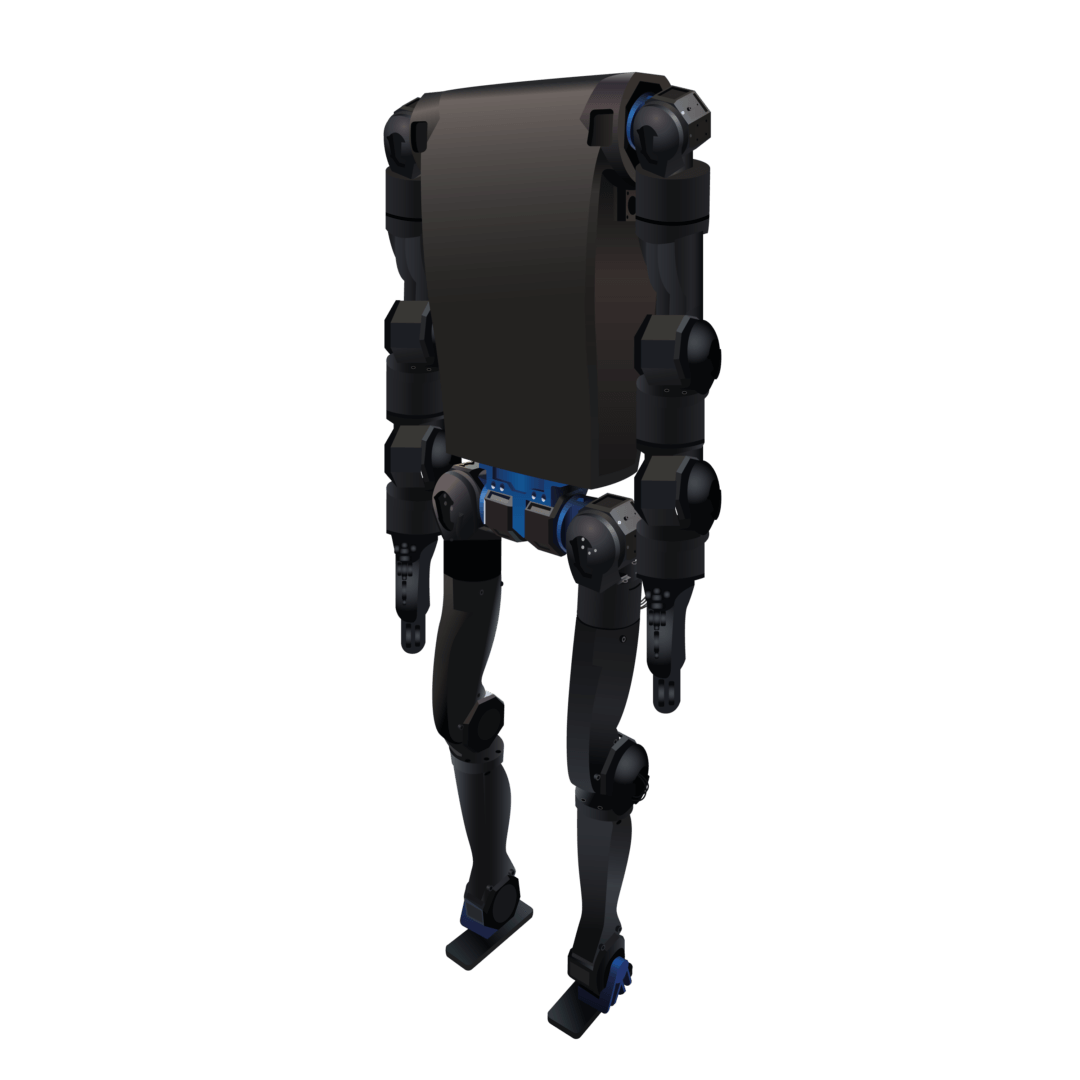
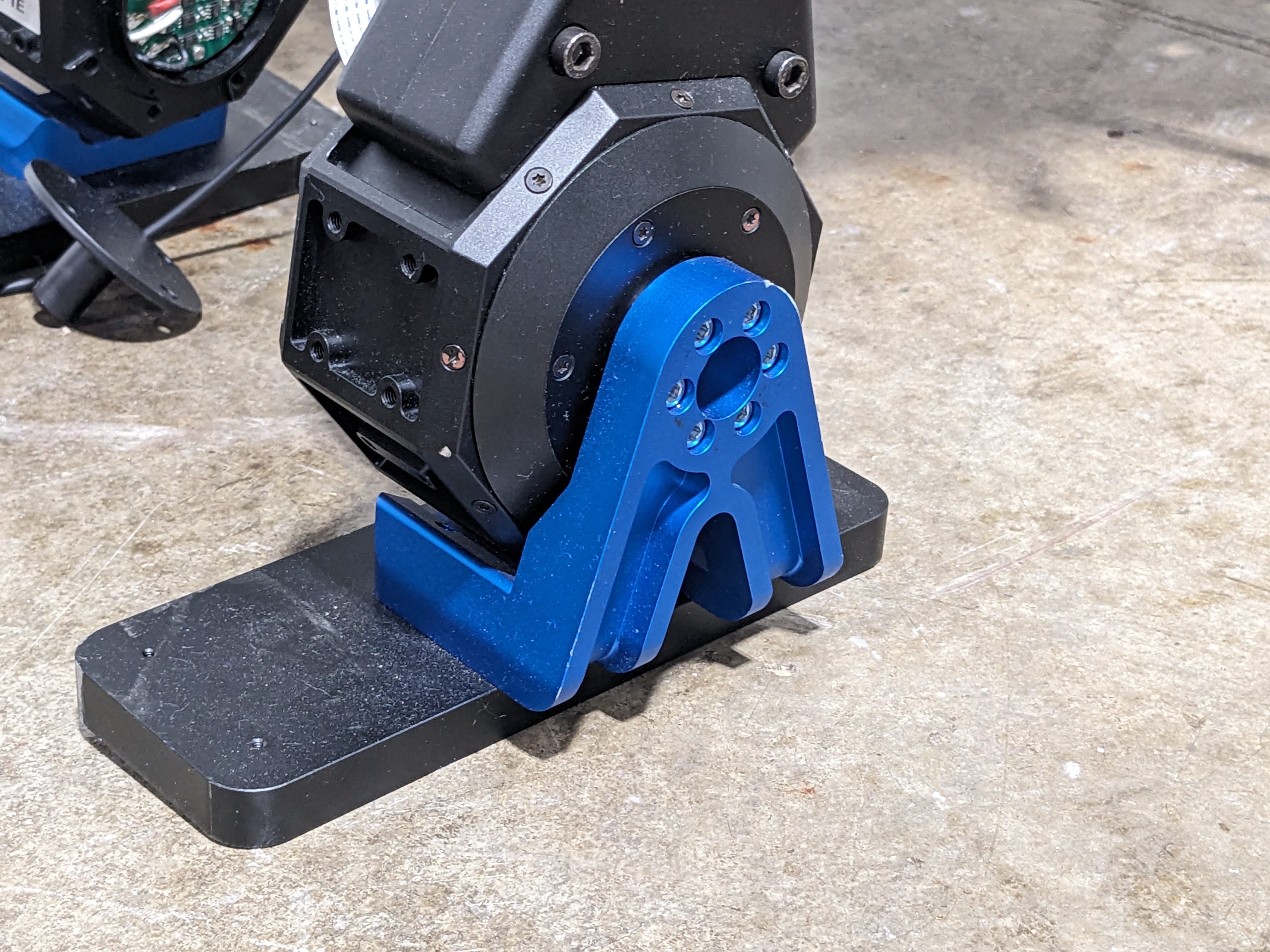
Rocky is a full-size biped built for locomotion research, controls development, and custom upper-body payloads. Each joint runs through one integrated quasi-direct-drive (QDD) actuator—the joint shaft is the motor output, with no external gearbox—so the mechanism you simulate is the mechanism on the lab floor.
The production chassis is machined aluminum. Rocky Lite uses the same actuation and electronics on a sheet-metal development frame with harnessing left accessible for bench work. Both ship from our shop in West Chicago.
At a glance
Platform
| Standing height (nominal) | ~1.58 m |
| Pelvis height | ~1.11 m |
| Mass (class) | ~45 kg |
| Actuated DOF | 22 (waist ×2, legs ×12, arms ×8) |
| Structure (Rocky) | Machined aluminum |
| Structure (Rocky Lite) | Sheet metal, exposed harnessing |
| Origin | Made in the USA; some imported components, including motors. NDAA-compliant. |
Typical package
| Included | 16 high-torque + 6 compact QDD modules, CM5 compute, 48 V battery, CAN harness, software bring-up support |
| Configure | Radios, end effectors, and project accessories in the quote builder |
Actuators and sensing
Rocky uses the same QDD module family as our Lynx high-torque leg drives. Modules talk over CAN at 1 Mbps. Each actuator carries dual 14-bit encoders; the torso includes an IMU for state estimation and balance work.
High-torque modules (×16)
| Peak / rated torque | 120 N·m / 40 N·m |
| Max / rated speed | 200 rpm / 167 rpm |
Compact modules (×6)
| Peak / rated torque | 14 N·m / 5 N·m |
| Max / rated speed | 315 rpm / 100 rpm |
Electrical
| Bus voltage | 48 V nominal |
| Field bus | CAN 1 Mbps |
| Encoders | Dual 14-bit per actuator |
| IMU | Torso-mounted |
Compute and interfaces
Onboard compute is a Raspberry Pi CM5 with Ethernet, Wi-Fi, and Bluetooth—the same class of stack we use on Sierra, Lynx, and our other development platforms. That keeps your bring-up path familiar if you already run ROS 2 or a custom middleware on our legged hardware.
Electronics
| Compute | Raspberry Pi CM5 |
| Networking | Ethernet, Wi-Fi, Bluetooth |
| Power | 48 V lithium battery system |
| Control interface | Open torque/position paths for sim-to-real work |
Walking research in the open
We publish training metrics and checkpoints from our biped locomotion stack—not as a sales demo, but so labs can see what the current controller does under disturbance. The live page runs the public policy in browser MuJoCo, refreshes training charts on a fixed cadence, and documents how scaffolded recovery fades out as policies mature.
Rocky learns to walk (live) — in-browser simulation, TensorBoard scalars we actually use to judge runs, and a plain-language methods note. It is not a physical robot livestream and it is not a claim that every failure mode is solved; it is the map of where the walking stack stands today.